


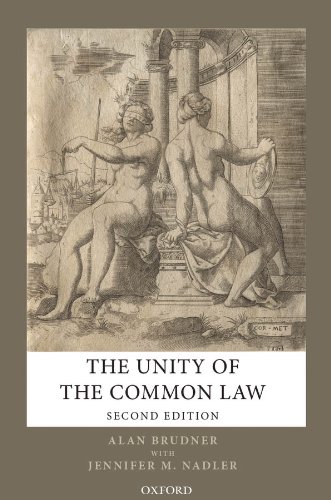
The Unity of the Common Law

 4.4 (134 items)
 Limited Time Sale
$15.72 cheaper than the new price!!
Free cash-on-delivery fees for purchases over $99
Product details
| Management number | 232007751 | Release Date | 2026/06/18 | List Price | $10.48 | Model Number | 232007751 | ||
|---|---|---|---|---|---|---|---|---|---|
| Category | |||||||||
In this classic study, Alan Brudner investigates the basic structure of the common law of transactions. For decades, that structure has been the subject of intense debate between formalists, who say that transactional law is a private law for interacting parties, and functionalists, who say that it is a public law serving the collective ends of society. Against both camps, Brudner proposes a synthesis of formalism and functionalism in which private law is modified by a common good without being subservient to it. Drawing on Hegel's legal philosophy, the author exhibits this synthesis in each of transactional law's main divisions: property, contract, unjust enrichment, and tort. Each is a whole composed of private-law and public-law parts that complement each other, and the idea connecting the parts to each other is also latently present in each. Moreover, Brudner argues, a single narrative thread connects the divisions of transactional law to each other. Not a row of disconnected fields, transactional law is rather a story about the realization in law of the agent's claim to be a dignified end-master of its body, its acquisitions, and the shape of its life. Transactional law's divisions are stages in the progress toward that goal, each generating a potential developed by the next. Thus, contract law fulfils what is incompletely realized in property law, negligence law what is germinal in contract law, public insurance what is seminal in negligence law, and transactional law as a whole what is underdeveloped in public insurance. The end point is the limit of what a transactional law can contribute to a life sufficient for dignity.Reconfigured and expanded with a contribution by Jennifer Nadler, The Unity of the Common Law stands out among contemporary theories of private law in that it depicts private law as purposive without being instrumental and as autonomous without being emptily formal. Read more
| ASIN | B00FHZZT86 |
|---|---|
| XRay | Not Enabled |
| ISBN13 | 978-0191002557 |
| Edition | 2nd |
| Language | English |
| File size | 1.8 MB |
| Page Flip | Enabled |
| Publisher | OUP Oxford |
| Word Wise | Enabled |
| Print length | 377 pages |
| Accessibility | Learn more |
| Screen Reader | Supported |
| Publication date | October 3, 2013 |
| Enhanced typesetting | Enabled |
Stencils



Contracts



Correction of product information
If you notice any omissions or errors in the product information on this page, please use the correction request form below.
Correction Request Form